 View larger
Robert Nicolson and a book bound in Paris for Queen Elizabeth I of England
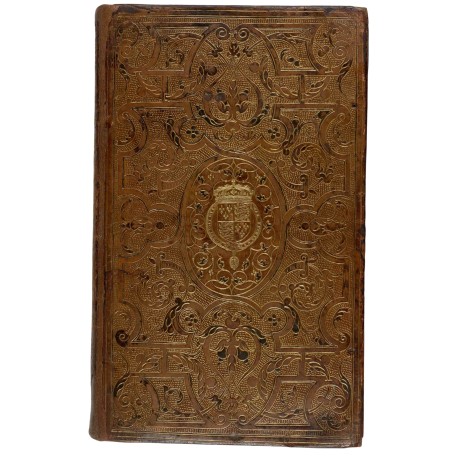
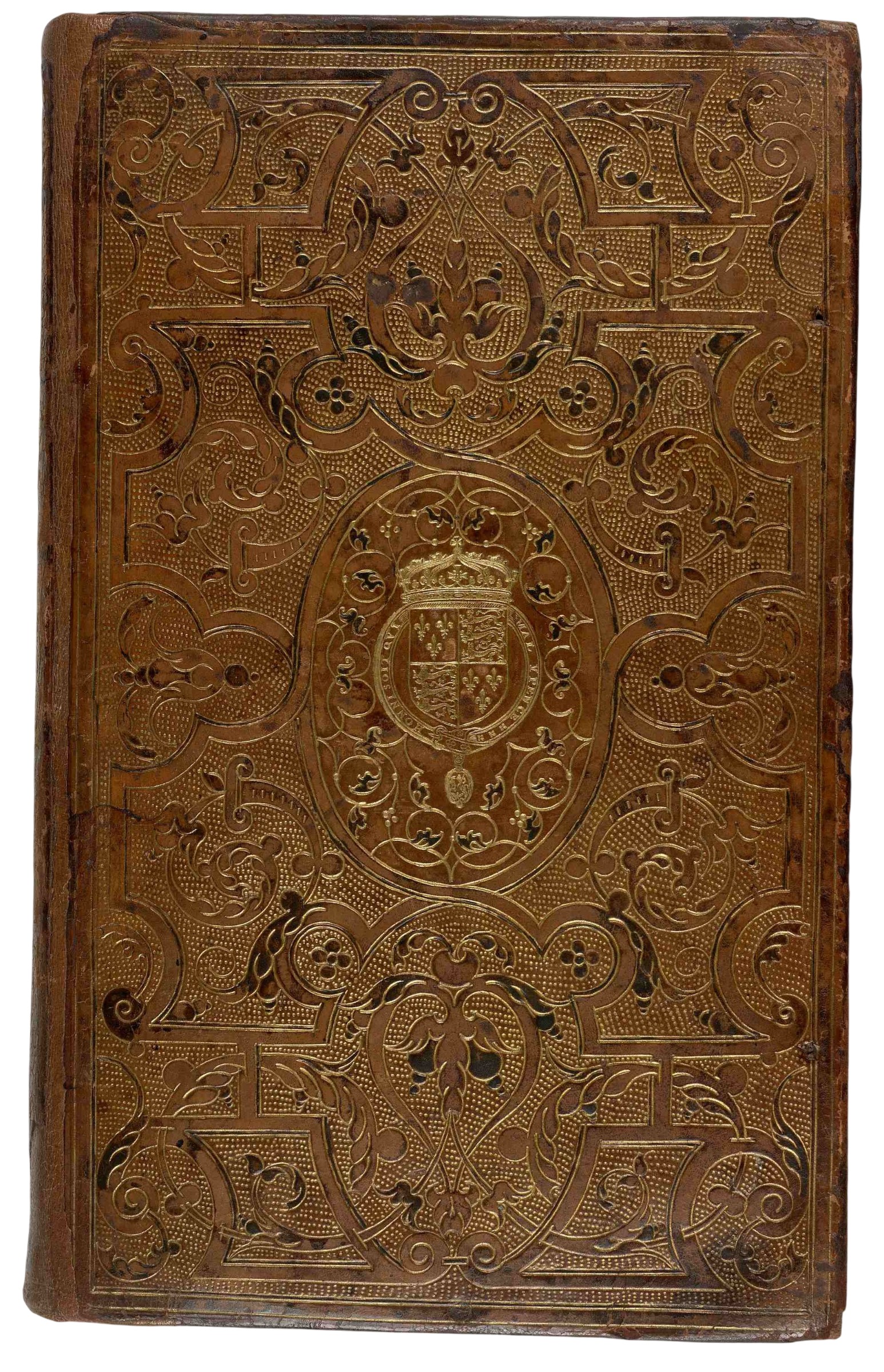
Among the many treasures of the Henry Davis Collection in the British Library is a binding of brown polished calf, tooled in gold to a complex design of interlacing fillets, scrollwork and foliage, on dotted background, with the arms of Elizabeth I, Queen of England, in gold, centred on the covers, surrounded by sprays of foliage painted black. It covers a copy of a history of the French monarchy, written by Nicole Gilles (d. 1503), and revised in 1562 by the royal historiographer, Denis Sauvage:
Nicole Gilles, Annales et croniques de France. Depuis la destruction de Troye jusques au temps du Roy Louys onzièsme, jadis composées par feu maistre Nicole Gilles, en son vivant secrettaire, indiciaire du Roy, & contrerolleur de son tresor. Imprimées nouvellement sur la correction de M. Denis Sauvage de Fontenailles en Brie, & additionnées, selon les modernes historiens, jusques à cest an mil cinq cens soixante & deux (Paris: Gabriel Buon, 1562)
The volume came to light in 1926, when the booksellers W.H. Robinson purchased and removed the library of Mrs Elizabeth Vesey (1715-1791), “Queen of the Bluestockings”, from the family’s ancestral mansion, Lucan House, near Dublin.1 It was acquired by the London bookseller E.P. Goldschmidt, who immediately offered it as “one of the finest Queen Elizabeth bindings in existence”,2 describing it afterwards as “one of the masterpieces of that great anonymous artist ‘l’incomparable doreur’”, the name given to an anonymous binder active in Paris ca 1553-1562 and responsible for a group of exceptionally luxurious bindings.3 In her catalogue of the bindings in the Henry Davis bequest, Mirjam Foot dated the binding ca 1562, and noted that it was decorated with tools used in the atelier of the relieur du roi Claude Picques.4
All discussion of this book to date has omitted any mention of an early owner and the remarkable embellishments he made to the volume: woodcut armorials (a small lozenge, and a quartered shield) pasted over the printer’s woodcut ornaments and initial letters, a larger woodcut armorial with crest and motto “Notitia nobile nomen” pasted in a chapter break, a non-verbal mark penned in a margin (an “e” with flanking periods), and the signature “Robert Nicolson” neatly incorporated in the printer’s device on the title of the second part.

Fig. 1. Examples of woodcut heraldic shields pasted by Robert Nicolson into his copy of Annales et croniques de France (from left, b4r g6r t1v); above, same pages in another copy. The heraldic insignia shown on b4r belong to families that Nicolson believed were his relations (Holcroft, Horton, etc.).

Fig. 2. Woodcut coat of arms of Robert Nicolson and woodcut insignia of his uncle, Sir John Branche, pasted into Robert’s copy of Annales et croniques de France over printers’ ornaments (x2v &5v); above, same pages in another copy.
This Robert Nicolson was born in 1561 at Bramley in Surrey, the son of Benjamin Nicolson and Joan (née Parvis), and was baptised at Holy Trinity, Guilford.5 His grandfather was a draper, and both Benjamin and Robert were free of the Draper’s Company. His paternal aunt, Helen, married secondly Sir John Branche, Draper, and Lord Mayor of London in 1580-1581. When she died on 29 April 1594, five years after her husband, Robert became her sole executor, and he sponsored several poetical tributes to her memory.6 Robert likewise enhanced and personalised his own copies of those elegies, with pasted-in woodcuts of the Nicolson family arms (or Branche impaling Nicolson), and with often extensive marginal notes.7 On 26 December 1594, Robert married a neighbour, Martha Carrell,8 and the first of their twelve children was born in 1598. After the death of his father in 1600, he took possession of the family property.9

Fig. 3. Left no. 26 Dame Helen Branche’s woodcut arms, displayed on a lozenge, the traditional indication of an unmarried woman or a widow (pasted on title verso; also pasted in no. 14 on t1 verso - see Fig. 1). Right no. 25 Woodcut Branche-Nicolson arms, displaying (Dexter side) the paternal arms of Sir John Branche, quartered with his maternal arms (Wilkinson), and (Sinister side) the family arms of Nicolson (pasted on title verso of Sylvester's Monodia; also pasted in no. 27 on title verso).

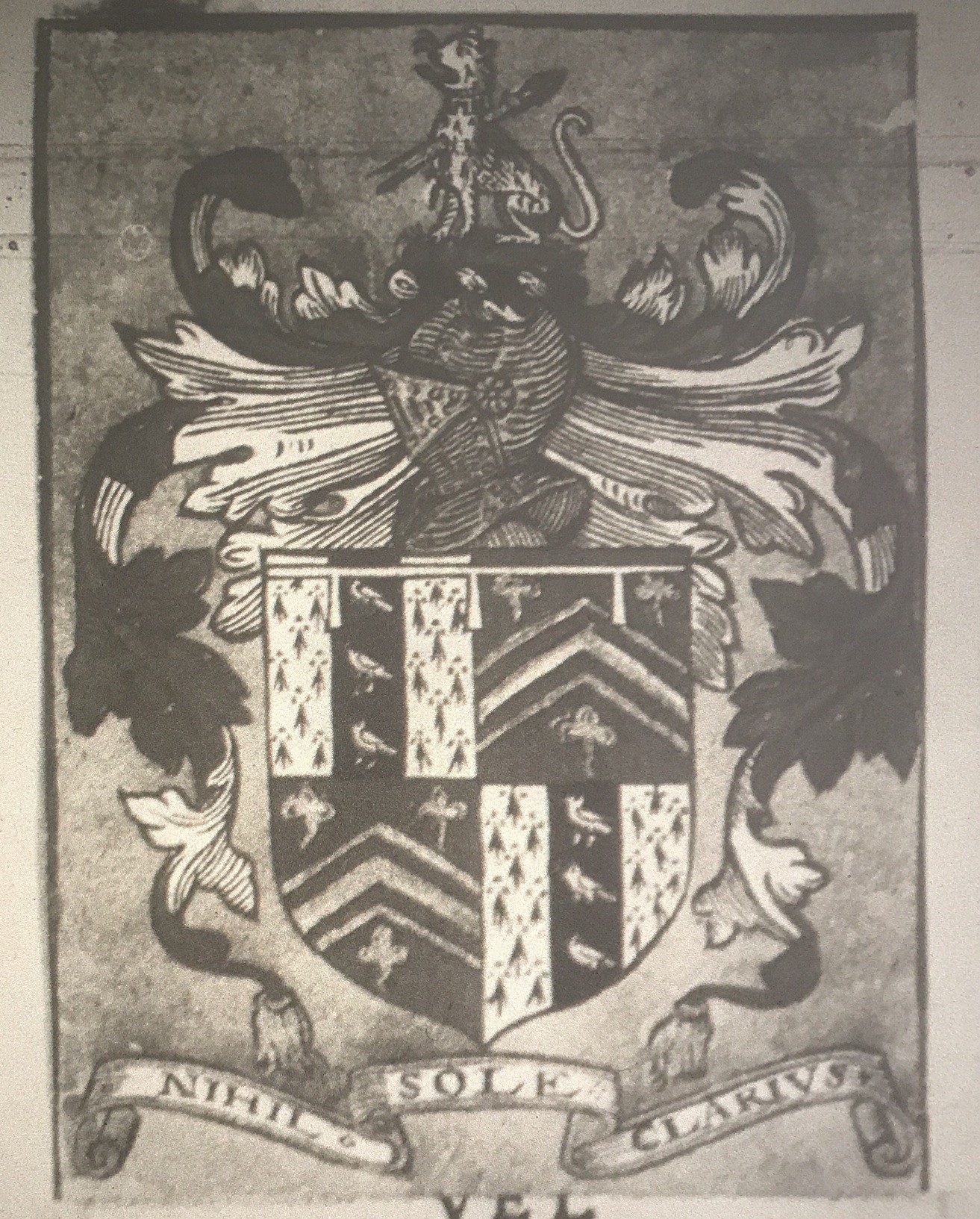
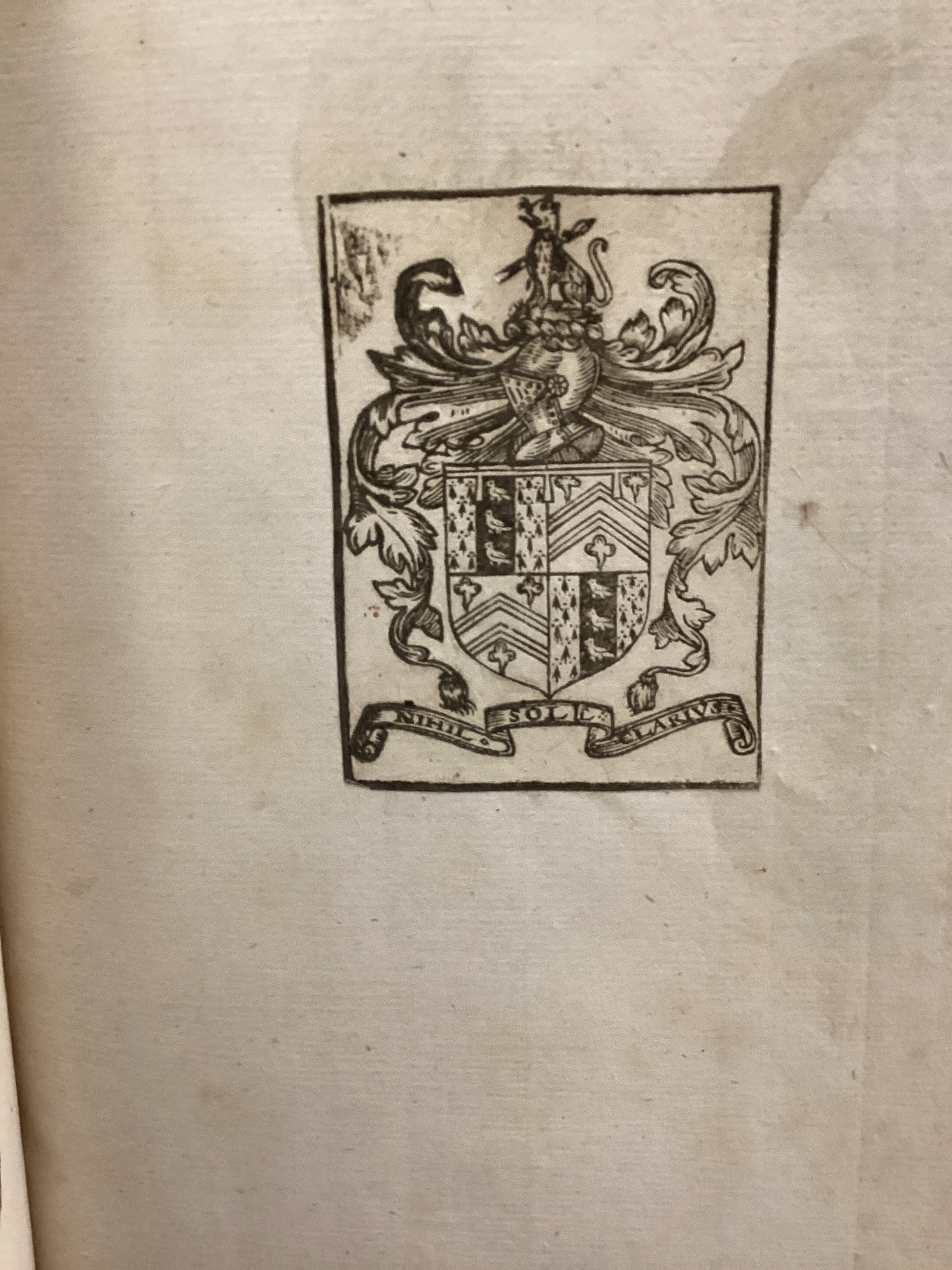
Fig. 4. Left no. 16 Robert Nicolson’s woodcut arms, pasted to A4v. Quarters 1 and 4 show Nicolson; quarters 2 and 3 show Compienie, an heiress who married into his father's family. A label of cadency (a horizontal bar with three downward points) indicates that this is Robert’s shield and that his father was still living. Right no. 17 The same arms with the family crest (a leopard with a broken spear piercing its neck) and motto, pasted on the title verso (also in no. 10).10 See Fig. 1 for a re-cutting without the label of cadency.

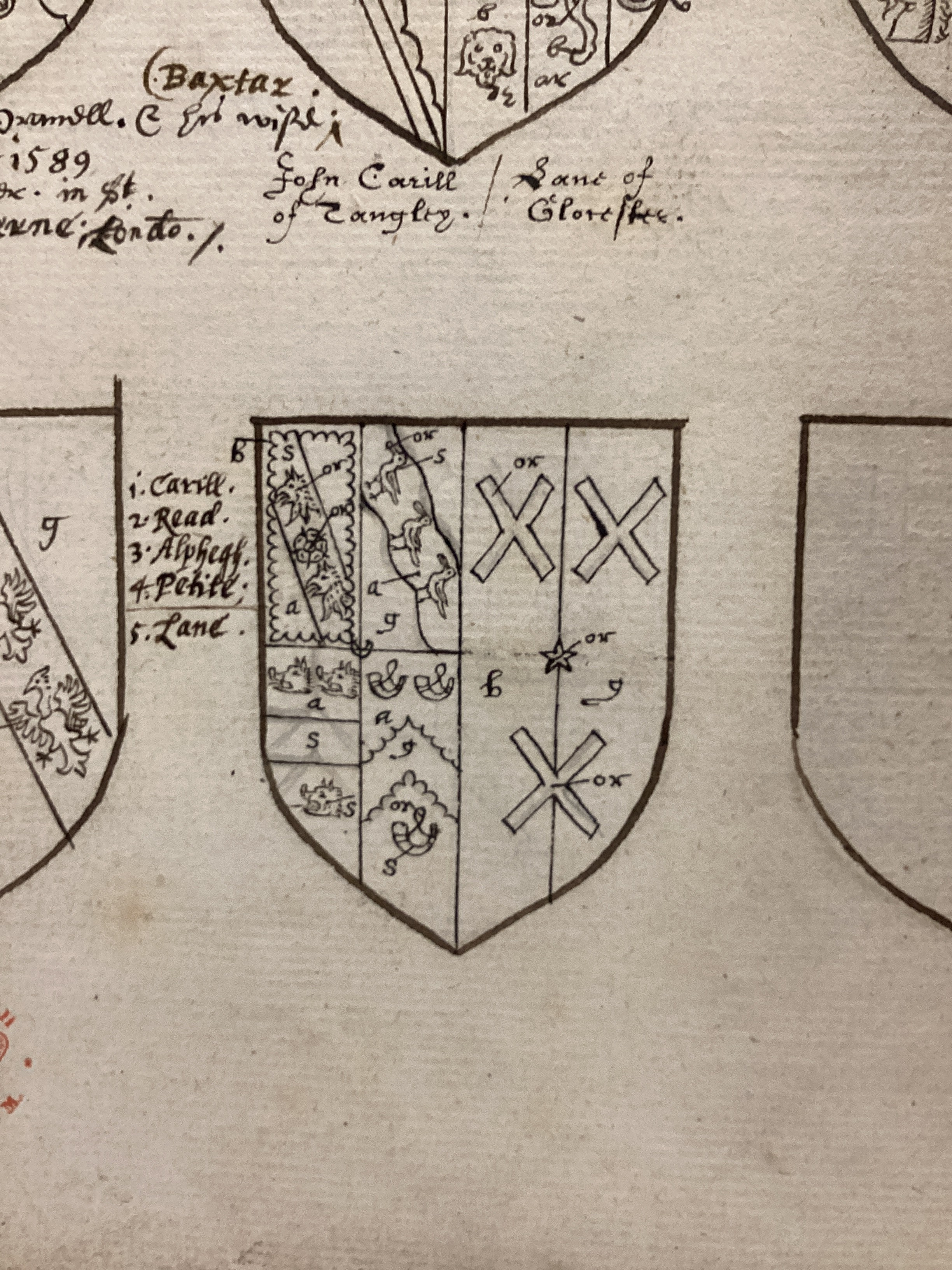
Fig. 5. Left no. 9 (E4v) Robert Nicolson’s woodcut arms impaled with those of his wife, Martha Carrell (Dexter side: Nicolson-Compienie; Sinister side: Martha’s paternal arms, 1. Carrell, 2. Reade, 3. Alphegh, 4. Lane). Right no. 14 (N2r) The same arms with a modified Sinister side in six divisions (adding 4. Petitt), featuring the same family crest, but a different motto.11
From manuscript entries Robert made in his books, we learn something of his early life. A marginal note in his copy of Hakluyt’s Principall Navigations (no. 15 in List below) indicates that both Robert and his uncle, Sir John Branche, were members of the English trading enterprise known as the Muscovy Company.12 Notes in his copy of Lloyd’s The first part of the diall of daies (no. 20) record his extensive travels as merchant between the Hanseatic cities, and an unforgettable encounter on 22 September 1587 outside Danzig with King Sigismund III Vasa of Poland, and his sister Princess Anna Vasa.13 In separate marginalia (no. 16), Robert mentions Cuthbert Buckle, a wholesale wine merchant, Alderman of London 1582-1594, Lord Mayor from October 1593 until his death in office in July 1594, as “my only Maister”.14 Buckle had built his fortune importing wine from Gascony (Bordeaux). A significant minority of Robert’s books (eleven of the twenty-nine listed below) was published in France, suggesting he travelled to Paris, and he likely acquired there his copy of Gilles’ Annales et croniques de France. Although the latter volume was bound for presentation, it bears no internal or external evidence of ever having entered the royal library.
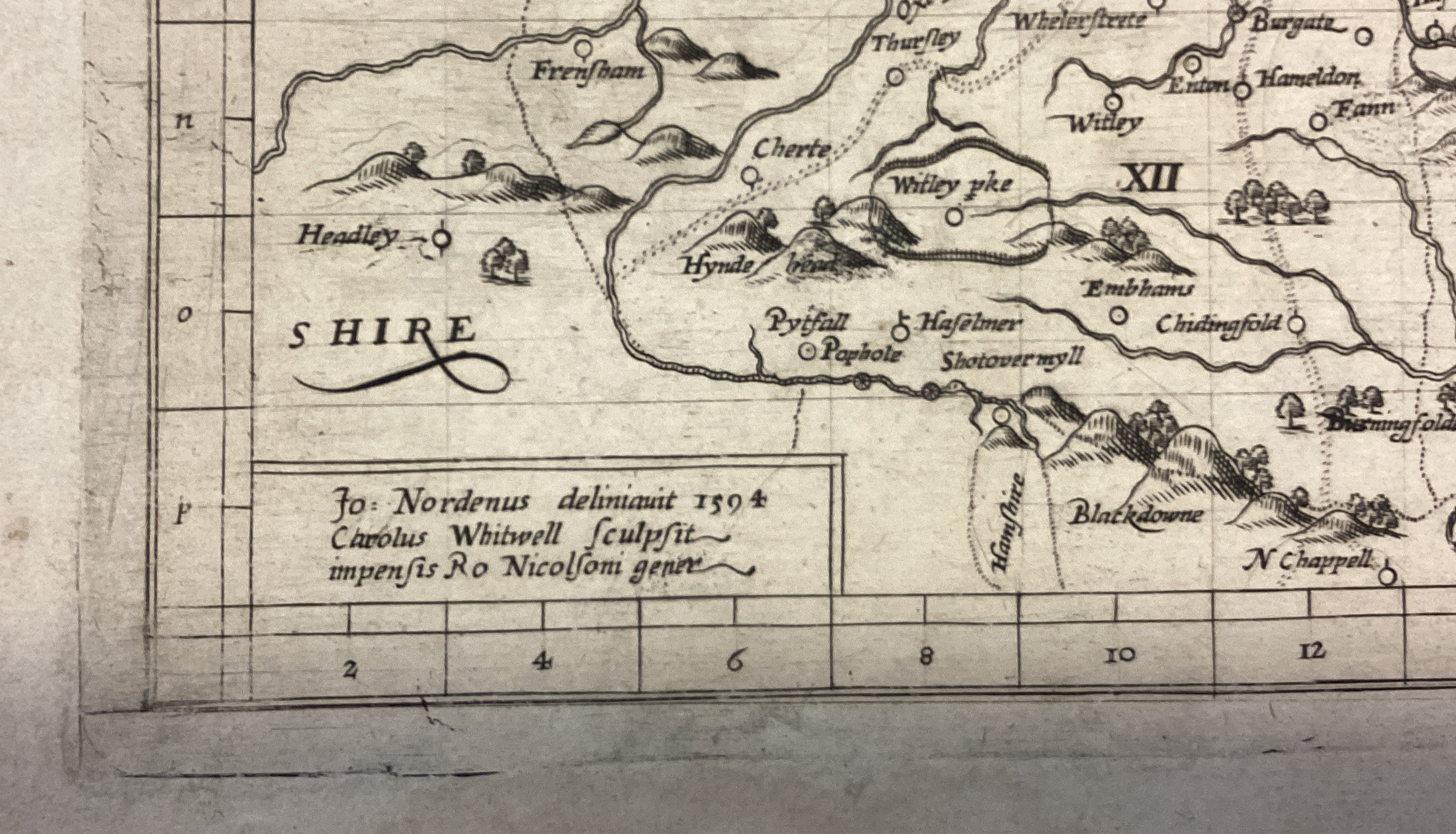
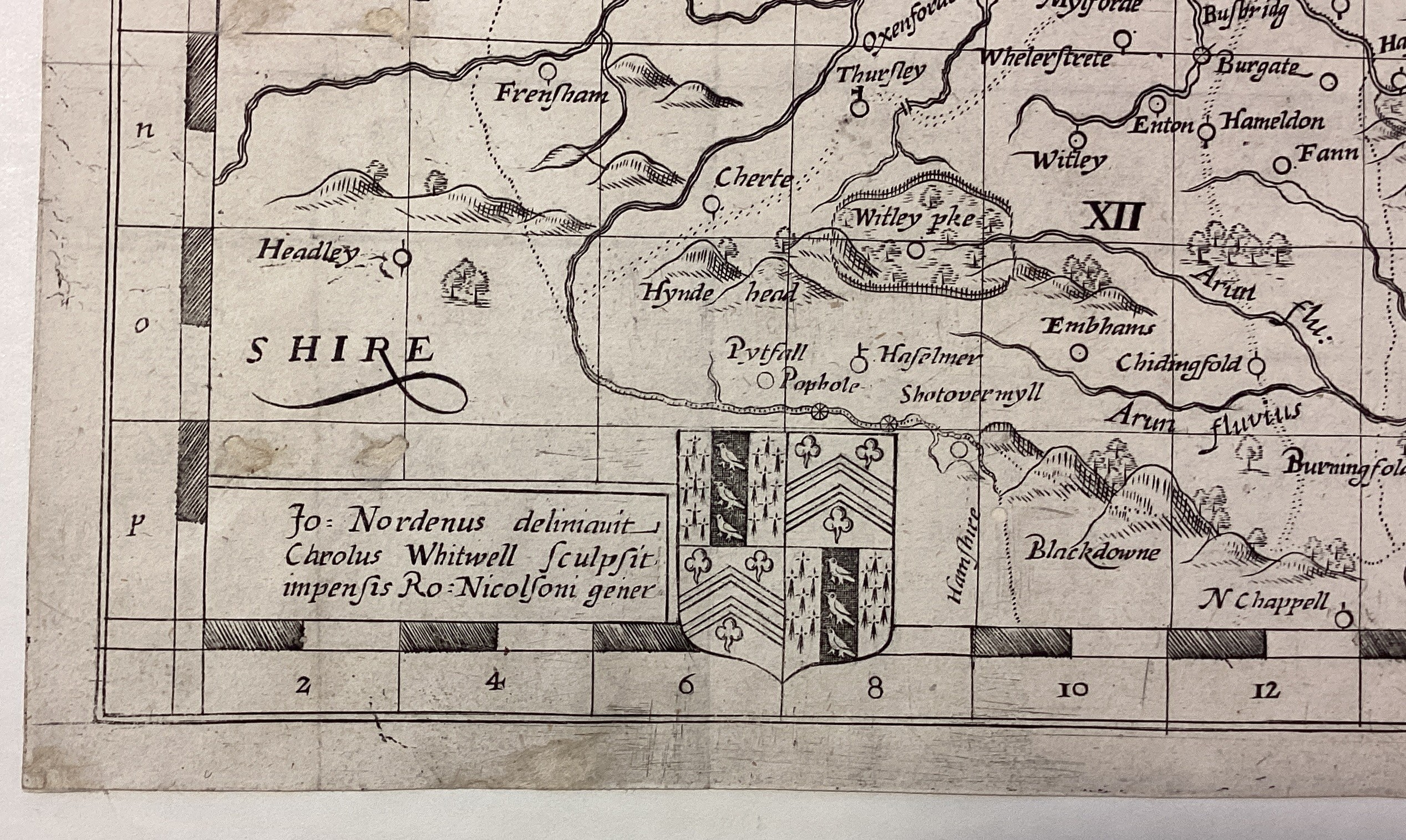
In the early 1590s, Robert became a close friend of Josuah Sylvester (1563-1618), then in the service of the Merchant Adventurers’ Company, but deeply dissatisfied with the cloth trade, and cultivating a poetic vocation. It is not known when the two met, however by 1594, when Sylvester wrote Monodia, a funeral elegy for Dame Helen Branche, he was already reliant on Nicolson’s patronage, and that relationship continued for decades. A recueil (no. 25) bound in contemporary gilt-stamped calf, the initials “R.N.” in gilt in the central cartouche, gathers (1) Nicolson’s own copy of Sylvester's Monodia (a woodcut of the Nicolson coat of arms is pasted to the title verso); (2) Sylvester’s translation of a French Protestant tract, The profit of imprisonment (1594), addressed by him “To the worshipful his approued frend maister Robert Nicolson marchant”, a special copy with gilt rules around the title and dedication; (3) Sylvester’s translation of Du Bartas’ The triumph of faith (1592); and the first part of John Norden’s Speculum Britanniae (1593), containing six elegiac couplets written by Nicolson (“Io. Nordeni vale, ad primam partem sui Specvli Britanniae”). In 1594, Nicolson sponsored publication of a map of Surrey, drawn by Norden, and engraved by Charles Whitwell “…impensis Ro Nicolsoni gener.” according to a legend placed at lower left.15 Nicolson also maintained a durable bond with John Norden, contributing a sonnet to Norden’s 1614 work, The labyrinth of mans life, addressed “To his deare friend Maister John Norden”.16
No researcher has yet answered the call to search parish and probate records, leaving the date of Nicolson's death unknown.17 It might be ca 1615, when Nicolson is said to have given valuable books to the Royal Grammar School, Guildford.18
Ownership inscriptions of Robert Nicolson

No. 2 The boke of secretes of Albertus Magnus ([1570?]) - Roberti Nicolsoni Londinensis liber (title)

No. 5 The Gospels of the fower Euangelistes (1571) - Ex Robti Nicolosoni Londinensis libris 1591 scor[?] 1/20 [purchase price] (title)

No. 5 The Gospels of the fower Euangelistes (1571) - Notitia nobile nomen q[uo]th Nicolson 1591 (title)

No. 7. Imagines deorvm (1581) - [Notitia nobile nomen?] q. Nicolson R 1593” (title)

No. 7 Imagines deorvm (1581) - Robert: Nicolson - Richard Lane his booke

No. 9 La Dance macabre (1500) - Le liure de Robert Nicolson, de Londres (E4v)

No. 12 Le debat des heraulx d’armes de france et d’engleterre - Nihil sole clarius . //. Robert Nicolson Anglois (title)

No. 13 Sensuit les croniques de France - Roberti Nicolsoni liber (title)

No. 13 Sensuit les croniques de France - Roberti Nicolsoni Londinensis liber . / . (M4v)

No. 14 Annales et croniques de France (1562) - Robert Nicolson (title)

No. 16 Epicedium, a funerall song (1594) - Inter honoratos dignaris habere poetas. R L[ondinensis]. 1594 (A4r)

No. 18 Polycronycon (1527) - Robti Nicolsoni Londinensis Liber 1589 C : 3 : 18 [cost] (title)

No. 18 The first part of the diall of daies (1590) - 1590. Ex Robti Nicolsoni Londinensis libris 13/12 [cost] (title)

No. 20 The first part of the diall of daies (1590) - With diuers Additions, By Robt Nicolsons industrie (title)

No. 22 De totius orbis descriptione (1507) - 1591, Roberti Nicolsoni Londinensis libr (title)

No. 24 The nauigations, peregrinations and voyages (1585) - Notitia nobile nomen q[uo]th Nicolson 1590 Libr [cost illegible] (title)
1. William H. Robinson, Catalogue 14: The Library of Mrs. Elizabeth Vesey, 1715-1791: The first of the blue-stockings, the friend of Laurence Sterne, Horace Walpole, Goldsmith, Gray, Sir Joshua Reynolds, Mrs. Montagu, etc., etc., and the hostess of Dr. Johnson and the ‘club’ (Newcastle-on-Tyne 1926), item 214 [link]. For a description of her library, see Maria Anita Stefanelli, “Elizabeth Vesey and the art of educating oneself, between London and Lucan” in Studi irlandesi. A Journal of Irish Studies 3 (2013), pp.323-334 [link].
2. E. P. Goldschmidt & Co., Catalogue 9: Rare and valuable books comprising incunabula, Americana, medicine, philosophy, science, art, bibliography (London 1926), item 199 & frontispiece [link].
3. E.P. Goldschmidt, Gothic & Renaissance bookbindings exemplified and illustrated from the author’s collection (London 1928), no. 231 & Pl. XCI, with a list of 23 comparable bindings. Marie-Pierre Laffitte, “D’autres reliures à attribuer à l’incomparable doreur?” in Revue française d’histoire du livre 86 (1982), pp.435-440 (p.435).
4. Mirjam Foot, The Henry Davis Gift: a collection of bookbindings, Volume III: A catalogue of South-European bindings (London 2010), no. 74. Compare Mirjam Romme [Foot], “Contemporary Collectors XLIV. The Henry Davis Collection I: The British Museum Gift” in The Book Collector 18 (1969), pp.23-44 (p.26); and her The Henry Davis Gift: a collection of bookbindings, Volume I: Studies in the history of bookbinding (London 1978), pp.160, 171.
5. Franklin B. Williams Jr., “Robert Nicholson, a Minor Maecenas” in Notes and Queries 199 (1954), pp.11-13.
6. Robert Nicolson received a pecuniary bequest of £100; see Jason Scott-Warren, “Cut-and-Paste Bookmaking: The Private/Public Agency of Robert Nicolson” in Early Modern English Marginalia (New York 2018), pp.35-50 (p.37, identifying Nicolson as “the orchestrator of this flurry of mourning verses for his aunt”). See below, Provisional list of books belonging to Robert Nicolson, nos. 16-17 (Hervey’s Epicedium), no. 26 (S.P., An epitaph), no. 27 (Phillips’ A commemoration). For discussion of these works, and also Josuah Sylvester’s Monodia. An elegie, in commemoration of the vertuous life, and godlie death of the right worshipfull & most religious lady, Dame Hellen Branch widdowe (London: Peter Short, 1594), see Jason Scott-Warren, Shakespeare’s first reader: the paper trails of Richard Stonley (Philadelphia 2019), pp.162-197. See British Library, Harley Ms 4013 (Coats of arms of English nobility), f.13r, for two distinct impaled coats of arms for Helen Branche, representing her marriages to John Mynors, a wealthy London draper, and Sir John Branche [image].
7. W. Bruce Bannerman, The visitations of the county of Surrey made and taken in the years 1530 by Thomas Benolte … 1572 by Robert Cooke … and 1623 by Samuel Thompson, Windsor Herald, and Augustin Vincent, Publications of the Harleian Society, 43 (London 1899), pp.83-84, who blazons the Nicolson arms as: “Quarterly: 1 and 4, Ermine, on a pale sable; three martlets or; 2 and 3, Gules, a chevron cotised between three trefoils slipped or.” and the crest as: “On a mount vert; an ounce sejant argent, spotted sable, thrust through the neck with a broken spear or, headed gules.” [link]. See also, Robert S. Boumphrey, Surrey coats of arms, edited 2011 by Barry and Linda Oliver [link].
8. Franklin B. Williams, Jr, “The Bear Facts about Joshua Sylvester, The Woodman” in English Language Notes 9 (1971), pp.90-98.
9. Last will and testament proved 15 February 1599/1600 (TNA Ref PROB 11/95/103, link; will abstract, link).
10. The motto “Nihil sole clarius” “appears to be a personal one of Robert’s own devising” concludes Williams, op. cit. 1954, p.12: “its rather elusive point rests in the imperfect canting of the medieval pronunciation nichil and the familiar pun of sun-son to give Nichil-son.” A loose, coloured impression of this woodcut was collected by John Bagford (1650-1716), and is preserved in British Library, Ms. Harl. 5291 (English printing: Marks of printers and publishers, woodcut and engraved borders, and miscellaneous woodcuts), f. 332 (image, [link]); see Melvin H. Wolf, Catalogue and Indexes to the Title-Pages of English Printed Books Preserved in the British Library’s Bagford Collection (London 1974), p.34 (unidentified). An image of that impression is available via EBBO (ProQuest document ID 2240872801, as “Unidentified armorial bearings”). Another impression is pasted in British Library, Harley Ms 4013 (Coats of arms of English nobility), f.26 recto (image, [link, link]).
11. See Bannerman, op. cit., p.88, for the Carrell arms [link]. In the British Library’s Harley MS 4013 (Coats of arms of English nobility, f. 24v [image]), a professional arms painter, likely William Lambert, tricked the impaled arms of John Carrell and Lettice Lane following their marriage in 1575. The achievement features the four quarterings of Carrell (1. Carrell, 2. Reade, 3. Alphegh, 4. Petitt) impaling the arms of Lane, marking Lettice’s status as the daughter and sole heir of Thomas Lane of Gloucestershire. For the motto, see Michael Siddons, A Dictionary of mottoes in England and Wales, Publications of the Harleian Society, 20 (London 2014), p.162. Nicolson wrote “Notitia nobile nomen” in nos. 5, 7, 18, 21 and 24.

12. Scott-Warren, op. cit. 2018, pp.40, 49. Nicolson became a member of the Muscovy Company in 1588, and was an Assistant to the Court of the Company in 1598.
13. Scott-Warren, op. cit. 2018, p.46.
14. Buckle’s role at Dame Helen’s funeral is recorded by Nicolson in a lengthy annotation in his copy of Hervey’s Epicedium (no. 16 in List below); see Scott-Warren, op. cit. 2018, p.47, and Scott-Warren, op. cit. 2019, pp.181-182. In Buckle’s will, Nicolson is referred to as his “late servant”, suggesting that Nicolson had left his employment before Buckle died.
15. Just two impressions of the original issue of this early and important map of Surrey seem to be known: one was acquired in an atlas factice by the Royal Geographical Society in 1919 (Map Room, CA15F-013 (063); opac, [link]); the other was sold by Sotheby’s, 14 December 1950, lot 344 (“The Property of Mrs. D.K. Shirley”), where bought by the British Museum (now British Library, Maps C.2.cc.3 [image]; see R.A. Skelton, “John Norden’s Map of Surrey” in The British Museum Quarterly 16 (1951), pp.61-62). A reissue of this map was formerly inserted in a copy of Ranulf Higden’s Polycronycon (1527) belonging to Robert Nicolson (see no. 18 in List below). Here, the Elizabethan royal arms displayed on the 1594 original is replaced by arms borne by James I, the date “1594” is erased from the legend (now “Jo: Nordenus deliniauit Carolus Whitwell sculpsit impensis Ro Nicolsoni gener.”), Nicolson’s coat of arms is added, and there are numerous other revisions and alterations. No other impression of this reissue, dated ca 1610 by Robin Flower Smith (“An Early Map of Surrey” in The British Museum Quarterly 3 (1928-1929), pp.16-17 & Pl. X), seems to be known [image]. See no. 18 in List below for speculation on the date of its extraction from Higden’s Polycronycon.
16. On the authorship of this sonnet, signed by the initials R.N. and an anagram of Nicolson’s name (Non luco, subter Rosis), see Williams, op. cit. 1954, p.13; and Franklin B. Williams, Jr, “An Initiation into initials” in Studies in Bibliography 9 (1957), pp.163-178 (p.170).
17. Williams, op. cit. 1954, p.13.
18. Owen Manning and William Bray, The history and antiquities of the county of Surrey (London 1804-1814), I, p.77 (“Other contributors of one or more Books, or money to be laid out in the purchase of them, from the first establishment of the Library to the present time, were in … 1615 Rob. Nicholson of Bramley”). “The sources for the list of donors published by Manning and Bray remain obscure” write Gwendolen Woodward and Richard A. Christophers, compilers of The Chained Library of the Royal Grammar School, Guildford: Catalogue (Guildford: Royal Grammar School, 1972), p.4, who include Robert Nicolson in their “Appendix C. Index of Donors” (p.75) though unable to identify any books of Nicolson provenance remaining in the library.
Provisional list of books belonging to Robert Nicolson
(1) Claudius Aelianus, A registre of hystories, conteining martiall exploites of worthy warriours, politique practises of ciuil magistrates, wise sentences of famous philosophers, and other matters manifolde and memorable. Written in Greeke, by Ælianus a Romane: and deliuered in Englishe (as well, according to the truth of the Greeke text, as of the Latine) by Abraham Fleming (London: [H. Middleton], for Thomas Woodcocke, 1576)
provenance
• Robert Nicolson, twelve-page Ms index to the work subscribed “Ex industria Roberti Nicolsoni Londiniensis 1590”
• unidentified owner, initials “H W” stamped in blind on covers
• Bernard Quaritch, London; their Catalogue 687: A selection of interesting books on a great variety of subjects (London 1951), item 4 (“old speckled calf, the initials H W in blind on the sides … At the beginning is bound up a MS. index to the work on 12 pages. It is signed at the end: ‘Ex industria Roberti Nicolsoni Londinensis 1590,’ the date being slightly cut into by the binder.”)
• Urbana, IL, University of Illinois at Urbana-Champaign, IUA00084 (opac Contemporary (dated 1590) table of contents inscribed on six leaves bound before title page [link])
literature
Jason Scott-Warren, “Cut-and-Paste Bookmaking: The Private/Public Agency of Robert Nicolson” in Early Modern English Marginalia (New York 2018), pp.35-50 (pp.42, 50)
Jason Scott-Warren, Shakespeare’s first reader: the paper trails of Richard Stonley (Philadelphia 2019), p.188
(2) ps-Albertus Magnus, The boke of secretes of Albertus Magnus, of the vertues of herbes, stones, and certayne beastes. Also, a boke of the same aucthor of the maruaylous thinges of the worlde: and of certaine effectes, caused of certayne beastes (London: William Seres, [1570?])
provenance
• Robert Nicolson, inscription “Roberti Nicolsoni Londinensis libr”
• Bertram Ashburnham, Earl of Ashburnham (1797-1878) (opac)
• Sotheby Wilkinson & Hodge, Catalogue of the magnificent collection of printed books the property of the Rt. Hon. the Earl of Ashburnham, London, 25 June-3 July 1897, lot 51 [link]
• Sotheran, London - bought in sale (£7 10s) [Temple Scott, Book sales of 1897, no. 3327; link]
• London, Guildhall Library, BAY H 5.1 NO 28 (opac Ms inscription: ‘Roberti Nicholsoni Londinesis liber’ - t.p. Binding: Full leather calf binding; gilt; marbled endpapers [link]); [this copy digitised via eebo - ProQuest document ID 2240889973]
literature
W. Carew Hazlitt, Bibliographical collections and notes on early English literature made during the years 1893-1903 [4th series] (London 1903), p.4 (“on the title occurs: Roberti Nicolsoni Londinensis liber” [link])
(3) Bede, the Venerable, Saint, Venerabilis Bedae presbyteri De temporibus sive de sex aetatibus huius seculi liber incipit. [edited by Pietro Maria Aleandro] (Paris: Jean I Marchant, Jean I Petit, 5 April 1507)
provenance
• Robert Nicolson, inscription “Roberti Nicolsoni Londinensis liber A° 1591” (Sotheby)
• Sir Francis Palgrave (1788-1861)
• S. Leigh Sotheby & John Wilkinson, Catalogue of the extensive and valuable library of the late Sir Francis Palgrave, London, 12-19 May 1862, lot 2218 ([together with nos. 8, 22, 23, 29 in this list] “in the original oak boards, covered with stamped leather … autograph of ‘Roberti Nicolsoni generosi liber A[nn]o 1591’” [link])
• Smith - bought in sale (1s 6d)
(4) Bible - The Holie Bible (London: Richard Jugge, 1568)
provenance
• Robert Nicolson, inscriptions “Robertus Nicolson, horum biblioru[m] … possessor: 1594” and “Robert Nicolson: 1594”
• Manchester, Chetham’s Library, A.7.18 (opac 16th-century MS. inscription on t.p.: “Robertus Nicolson, horum biblioru[m] … possessor: 1594” and on colophon: “Robert Nicolson: 1594.” … Chetham’s Library acquisition date chetacq 16560521. Chetham’s Library accession register chetreg 0258 [link])
literature
Jason Scott-Warren, “Cut-and-Paste Bookmaking: The Private/Public Agency of Robert Nicolson” in Early Modern English Marginalia (New York 2018), pp.35-50 (p.49)
Jason Scott-Warren, Shakespeare’s first reader: the paper trails of Richard Stonley (Philadelphia 2019), p.183
(5) Bible - Gospels, Anglo-Saxon and English, The Gospels of the fower Euangelistes translated in the olde Saxons tyme out of Latin into the vulgare toung of the Saxons, newly collected out of auncient monumentes of the sayd Saxons, and now published for testimonie of the same (London: John Daye, 1571)

provenance
• Robert Nicolson, inscriptions “Ex Robti Nicolosoni Londinensis libris 1591 scor[?] 1/20” and “Notitia nobile nomen q.th Nicolson 1591” on title page
• William Wotton, inscription “Wm Wotton 16” (rest trimmed by binder) on title page, presumably the philologist William Wotton (1666-1727)
• Earls of Macclesfield, blind stamp on title page
• Sotheby’s, The Library of the Earl of Macclesfield removed from Shirburn Castle, Part seven: Bibles, 1477-1739, London, 11 April 2006, lot 2319 (“Robert Nicholson of London, inscription on title-page dated 1571 [sic!!]; William Wotton, inscription on title-page dated 168-(cropped), probably the linguist and theologian (1666-1727)”)
• Sokol Books, London - bought in sale (£6500), sold 2010 to
• Oklahoma City, OK, Green Collection, donated in 2020 to
• Washington, DC, Museum of the Bible, BIB.001281 (digitised, link)
literature
Jennifer Atwood & Stacey L. Douglas, eds., “Passages: Exploring the Bible in Four Movements - An Exhibition Guide” (Oklahoma City 2015), 70
Jason Scott-Warren, “Cut-and-Paste Bookmaking: The Private/Public Agency of Robert Nicolson” in Early Modern English Marginalia (New York 2018), pp.35-50 (p.49)
Jason Scott-Warren, Shakespeare’s first reader: the paper trails of Richard Stonley (Philadelphia 2019), p.183
(6) Georg Braun & Franz Hogenberg, Civitates Orbis Terrarvm. Liber Primvs-[Tertivs] (Cologne: Gottfried von Kempen, 1581-1582)
provenance
• Robert Nicolson, inscription dated 1593 (opac)
• E.I. & H. Lloyd, exlibris (opac)
• New York, NY, New York Public Library, *KB+ 1581 (opac With autograph of Robert Nicolson, 1593 [link])
literature
Jason Scott-Warren, “Cut-and-Paste Bookmaking: The Private/Public Agency of Robert Nicolson” in Early Modern English Marginalia (New York 2018), pp.35-50 (p.42)
Jason Scott-Warren, Shakespeare’s first reader: the paper trails of Richard Stonley (Philadelphia 2019), pp.183, 188
(7) Vincenzo Cartari, Imagines deorvm, qvi ab antiqvis colebantvr : in quibus simulacra, ritus, caerimoniae, magnaq[ue] ex parte veterum religio explicatur (Lyon: Étienne Michel, 1581)
provenance
• Richard Lane, inscription “Richard Lane his booke” on title, and cost code [presumably a relation of Robert Nicolson’s mother-in-law, Lettice Lane, daughter of Thomas Lane of Gloucestershire; perhaps the Richard Lane who d. 1583 at Cheltenham?]
• Robert Nicolson, inscription (cropped) “[Notitia nobile nomen?] q. Nicolson R 1593” and “Robert: Nicolson”, woodcut armorial (Nicolson-Carrell arms, as Fig. 5 left above),
• Julian Watson Bradshaw (1824-1907)
• Puttick & Simpson, The Watson Bradshaw Collection. Catalogue of a large and valuable assemblage of patristic, classical, and miscellaneous literature, London, 14-15 June 1894, lot 196 (part lot, one volume of six “Early books of emblems”: Imagines Deorum, Lugduni, 1573 [sic!], old autographs on title of Robert Nicolson and Richard Lane his booke”)
• Cowper - bought in sale (£1 1s) [Book Prices Current, vol. 8, p.386 no. 5781 - link]
• Guy Bechtel (b. 1931), exlibris (lettered “Le Bibliophobe Bechtel In carcere meo liber”)
• Ader Picard Tajan, Bibliothèque Guy Bechtel: alchimie - magie - sorcellerie, Paris, 14-16 Novembre 1978
• unidentified owner - bought in sale (FF 1000) [Matterlin, Catalogue bibliographique des ventes publiques 1978-1979 et 1979-1980, p.156]
• Librairie Beaumanoir, Bagnolet, France (“ex-libris manuscrit de Robert Nicolson et de Richard Lane sur la page de titre; étiquette de la bibliothèque de Guy Bechtel (essayiste, journaliste, historien et biographe, homme de presse et d?édition.) sur le contreplat supérieur. ” [link])
(8) Quintus Curtius Rufus, De gestis Alexãdri Magni diligẽtiori examine nuper castigati (Paris: Poncet Le Preux, 1508)
provenance
• Robert Nicolson, inscription “Roberti Nicolsoni Londinensis liber 1591” (Sotheby)
• Sir Francis Palgrave (1788-1861)
• S. Leigh Sotheby & John Wilkinson, Catalogue of the extensive and valuable library of the late Sir Francis Palgrave, London, 12-19 May 1862, lot 2218 ([together with nos. 3, 22, 23, 29 in this list] “in the original oak boards, covered with stamped leather … with autograph of ‘Roberti Nicolsoni Londinensis liber 1591’” [link])
• Smith - bought in sale (1s 6d)
• unidentified owner, signature “J.C. Feildus” (?) on title (Sotheby)
• Albert Ehrman (1890-1969)
• John Ehrman (1920-2011)
• Sotheby Parke Bernet & Co., Catalogue of valuable printed books from the Broxbourne Library illustrating the spread of printing, 8-9 May 1978, lot 451 (“nineteenth century half calf … ownership inscription on title ‘Roberti Nicolsoni Londonensis [sic!] liber, 1591’”)
• Lathrop C. Harper, New York - bought in sale (£130)
literature
Jason Scott-Warren, “Cut-and-Paste Bookmaking: The Private/Public Agency of Robert Nicolson” in Early Modern English Marginalia (New York 2018), pp.35-50 (p.49, unlocated)
Jason Scott-Warren, Shakespeare’s first reader: the paper trails of Richard Stonley (Philadelphia 2019), p.277 (fn 60)
(9) La Dance macabre (Paris: Nicole de La Barre for Jean Tréperel, 23 July 1500)

provenance
• Robert Nicolson, inscription “A Paris. 1500” on title, his usual ink foliation, inscribed “Le liure de Robert Nicolson, de Londres” beneath the printer’s device (E4v), with below a pasted woodcut coat of arms [see above, Fig. 5; according to the Material Evidence in Incunabula (mei) database, the same woodcut is found in the Franks bequest: Catalogue of British and American book plates bequeathed to the Trustees of the British Museum by Sir Augustus Wollaston Franks (London 1904), II, p.300 no. 21866 (“Arms. Nicholson quartering Cardonel or Spyer” [sic!!]; mei, link]
• John Morris (ca 1580-1658), his library bought by King Charles II in 1661 (mei: “Attributed to Morris in the 1761 MS. catalogue of the Old Royal Library … presumably on the basis of the binding, or a note in the copy, no longer extant.”)
• London, British Library IA 40884 (formerly shelfmark C.32.g.19; originally shelfmark C.32.g.4 (2), second in a recueil containing also nos. 12-13 in this list)
literature
Lilian G. Clark, Collectors and owners of incunabula in the British Museum: index of provenances for books printed in France, Holland, and Belgium (Bath 1962), p.32 (“Arms, Erm. per pale sa 3 martlets or, being the first quarter of the arms of Nicolson of Balrath, Burry, Ireland [sic!!]. Emundson [A Complete body of heraldry, 1780, vol. II] gives the above quarter as of Nicolson, London, 1588”)
T.A. Birrell, The library of John Morris: the reconstruction of a seventeenth-century collection (London 1976), p.22 no. 459
Julia Boffey, Manuscript and Print in London c.1475-1530 (London 2012), p.67
Jason Scott-Warren, “Cut-and-Paste Bookmaking: The Private/Public Agency of Robert Nicolson” in Early Modern English Marginalia (New York 2018), pp.35-50 (p.49)
Jason Scott-Warren, Shakespeare’s first reader: the paper trails of Richard Stonley (Philadelphia 2019), p.183
(10) George Dicker, Discors concordia papae: vel antithesis antichristi cum Christo, per G.D. Cum responsione invectiua Terr. Or. Roman. in eadem. Oratio item pia pro Regina nostra Elizabetha (London: Richard Johnes, 1595)

provenance
• Robert Nicolson, rectangular armorial exlibris, featuring motto “Nihil sole clarius” on a banderol, and initials “R N” beside the crest, pasted to verso of title-page
• New York, NY, Union Theological Seminary, Burke Library, McAlpin, 1595 D54 (opac [link]; this copy digitised via eebo - ProQuest document ID 2264215062)
literature
Charles R. Gillett, Catalogue of the McAlpin collection of British history and theology, Volume I: 1500-1640 (New York 1927), p.142 [link]
Franklin B. Williams Jr., “Robert Nicholson, a Minor Maecenas” in Notes and Queries 199 (1954), pp.11-13 (p.12: “matching the blazon in the Surrey Visitation, except that it is differenced with a label of three points since Robert’s father was alive”)
(11) Antoine Du Verdier, La prosopographie, ou, Description des personnes insignes enrichie de plusieurs effigies, & reduite en quatre liures (Lyon: Antoine Gryphe, 1573), bound with Antoine Du Verdier, Les omonimes satire des moeurs corrompues de ce siecle (Lyon: Antoine Gryphe, 1572)
provenance
• Robert Nicolson, inscription “Liber Robti Nicolson; 1592” on title-page, presumably his annotations and his armorial (opac)
• Thomas Kerrich (1748-1828), inscription “T. Kerrich M.C.C. [Magdalene College Cambridge]” on front free endpaper
• Cambridge, Fitzwilliam Museum [shelfmark unknown] (opac sprinkled calf; raised bands, g. lettering on brown spine label; a.e. sprinkled red & brown. Provenance: ms. inscr. on front free e.p.: “T. Kerrich M.C.C.”. Ms. inscr. on t.p.: “Liber Robti Nicolson; 1592”. Unidentified bkpl. on p.40. Ms. annotations. [link, link])
literature
Jason Scott-Warren, “Cut-and-Paste Bookmaking: The Private/Public Agency of Robert Nicolson” in Early Modern English Marginalia (New York 2018), pp.35-50 (p.49)
Jason Scott-Warren, Shakespeare’s first reader: the paper trails of Richard Stonley (Philadelphia 2019), p.183
(12) France - Le debat des heraulx d’armes de france et d’engleterre (Rouen: Richard Auzoult for Thomas Laisné, [n.d.; 1505?])

provenance
• unidentified owner, title inscribed “Iean Mavrice”
• Robert Nicolson, inscribed “Nihil sole clarius . //. Robert Nicolson Anglois” on title, pasted woodcut coat of arms (D4r), inscription “Roberti Nicolsoni Londinensis liber” (D4v), annotations (D3r D3v), Nicolson’s usual ink foliation
• John Morris (ca 1580-1658), his library bought by King Charles II in 1661
• London, British Library, C.32.g.4 (formerly shelfmark C.32.g.4 (1), first in a recueil containing also nos. 9 and 13 in this list)
literature
T.A. Birrell, The library of John Morris: the reconstruction of a seventeenth-century collection (London 1976), p.22 no. 463
(13) France - Sensuit les croniques de France abregees Auec la generation de Adam … auec les noms de tous les Roys de France (Paris: Widow of Jean Tréperel, [n.d.; after 25 April 1518]

provenance
• Robert Nicolson, inscribed “Roberti Nicolsoni liber” on title, “Roberti Nicolsoni Londinensis liber . / .” (M4v), marginalia, Nicolson’s usual ink foliation
• John Morris (ca 1580-1658), his library bought by King Charles II in 1661
• London, British Library, C.32.g.18 (formerly shelfmark C.32.g.4 (3), third in a recueil containing also nos. 9 and 12 in this list)
literature
T.A. Birrell, The library of John Morris: the reconstruction of a seventeenth-century collection (London 1976), p.18 no. 388 and p.27 no. 587 (entry repeated)
(14) Nicole Gilles, Annales et croniques de France. Depuis la destruction de Troye jusques au temps du Roy Louys onzièsme, jadis composées par feu maistre Nicole Gilles, en son vivant secrettaire, indiciaire du Roy, & contrerolleur de son tresor. Imprimées nouvellement sur la correction de M. Denis Sauvage de Fontenailles en Brie, & additionnées, selon les modernes historiens, jusques à cest an mil cinq cens soixante & deux (Paris: Gabriel Buon, 1562)

provenance
● Robert Nicolson, inscription “Robert Nicolson” on second title-page (A1r), pasted in woodcut armorials (on b4r, g6r, t1v, x2v, &5v, N2r), annotation “⋅ e ⋅” (a1r)
● Mrs Elizabeth Vesey (1715-1791), engraved exlibris “Mrs Vesey” (plate signed “[Henry] Gretton sculp”)
● William H. Robinson, Newcastle-on-Tyne; their Catalogue 14: The Library of Mrs Elizabeth Vesey 1715-1791, the first of the blue-stockings (Newcastle-on-Tyne 1926), item 214 (£95; “Grolieresque binding for Queen Elizabeth” [link])
● E. P. Goldschmidt & Co., London; their Catalogue 9: Rare and valuable books comprising incunabula, Americana, medicine, philosophy, science, art, bibliography (London 1926), item 199 (£360) & frontispiece [link] [pencil inscriptions: Goldschmidt stock number “#4477”, catalogue reference “IX/199”, shop shelf location “B6”]
● Lucius Wilmerding (1880-1949)
● Parke-Bernet Galleries, The notable library of the late Lucius Wilmerding, Part III, New York, 29-31 October 1951, lot 405 (“Pasted at bottom of leaf lxxiiii of the second vol. is a coat of arms displaying the motto Notitia Nobile Nomen”) [RBH 1278-405]
● unidentified owner - bought in sale ($1600) [Book Auction Records, vol. 49, p.196]
● Henry Davis (1897-1977), commemorative exlibris (Davis inventory P.1063)
● London, British Library, Davis 397 (image, [link])
.jpg)
literature
Grolier Club, Catalogue of an exhibition of Renaissance bookbindings (New York 1937), p.43 no. 17
Mirjam Foot, The Henry Davis Gift: a collection of bookbindings, Volume I: Studies in the history of bookbinding (London 1978), pp.160, 171
Mirjam Foot, The Henry Davis Gift: a collection of bookbindings, Volume III: A catalogue of South-European bindings (London 2010), no. 74 (“A binding made in Paris for Queen Elizabeth I of England, c. 1562")
(15) Richard Hakluyt, The principall navigations, voiages and discoveries of the English nation, made by sea or ouer land, to the most remote and farthest distant quarters of the earth at any time within the compasse of these 1500. Yeeres (London: George Bishop and Ralph Newberie, for Christopher Barker, 1589)
provenance
• Robert Nicolson, inscribed “Ex Roberti Nicolsoni, Londinensis libris 1590” and cost “9/2.0” on title-page, half-sheet woodcut map extraneous to the book presumably added by him
• Thomas Jolley, FSA (1783-1854)
• Puttick & Simpson, Catalogue of the sixth portion of the valuable library of Thomas Jolley, Esq., FSA, London, 15-19 June 1852, lot 500 (“on the title is written, ‘Ex Roberti Nicolsoni, Londinensis, libris, 1590.’ Throughout the volume are copious marginal Manuscript Notes, apparently by the son, Robert Nicholson; and at p. 302 … is added: ‘Robert Nicolson the elder was also admitted into this Right Worshipful Fellowship, the 15th of February 1588-9; and was chosen one of the same Fellowship, March 1, 1598-9.’”)
• “Young” - bought in sale (£10 10s)
• S. Leigh Sotheby & John Wilkinson, Catalogue of the residue of the valuable library of the late Thomas Jolley, Esq., FSA, London, 16 January 1855, lot 211
• unidentified owner - bought in sale (£19) (Payne)
• J.W. Draper, inscription (opac), perhaps John William Draper (1811-1882), founder of the New York University School of Medicine
• New York, NY, New York Public Library, *KC+ 1589 copy 1 (G.K. Hall printed catalogue, “With many marginal ms. notes, with inscription: Ex Roberti Nicolsoni; Londinensis libris. 1590, and with autograph of J. W. Draper.” [link])
literature
Jason Scott-Warren, “Cut-and-Paste Bookmaking: The Private/Public Agency of Robert Nicolson” in Early Modern English Marginalia (New York 2018), pp.35-50 (pp.39-40)
Jason Scott-Warren, Shakespeare’s first reader: the paper trails of Richard Stonley (Philadelphia 2019), pp.183-186
Anthony Payne, “A New Census of Hakluyt’s Principall Navigations (1589)” in Journal of the Hakluyt Society, May 2026, p.27 (“The book’s reappearance in the second [Jolley] sale might be because it failed to reach its reserve price in 1852 (‘Young’, therefore, being the auctioneer’s buying-in name), or that it was returned as imperfect (which seems unlikely in this instance), or that the buyer in 1852 defaulted, or that the buyer in 1852 submitted it for sale in the 1855 auction hoping to make a profit (which, if so, he did).” [link])
(16) William Hervey, Baron Hervey of Kidbrooke, Epicedium, a funerall song, vpon the vertuous life, and godly death, of the right vvorshipfull the Lady Helen Branch (London: Thomas Creede, 1594)

provenance
• Robert Nicolson, marginalia in his italic hand throughout, transcription of the text on the monument erected in Dame Helen’s memory in St Mary Abchurch, with English verses subscribed by Nicolson and Josuah Sylvester, and woodcut armorial pasted in margin (all on A4v)
• Thomas Park (1759-1834), sold ca 1804 to
• Thomas Hill (1760-1840), inscription “Tho. Hill” on title-page
• Longman, Hurst, Rees, Orme, and Brown, London; their Bibliotheca anglo-poetica: or, A descriptive catalogue of a rare and rich collection of early English poetry (London 1815), pp.98-99 no. 246 [link] [3 works in one volume, morocco, nos. 16 Epicedium; 27 Commemoration of the Life; 26 Epitaph on the virtuous life in this List]; Catalogue of an extensive collection of old books (London 1816), item 6564 [link]; A catalogue of old books, in the ancient and modern languages and various classes of literature (London 1817), item 4968 [link]
• Mark Masterman Sykes (1771-1823)
• Evans, Catalogue of the splendid, curious, and extensive library of the late Sir Mark Masterman Sykes, Bart., Part the first, London, 11-23 May 1824, lot 1159 ([three works in one volume, as above] “red morocco. This most curious volume formerly belonged to Mr Park. It is described in the Bibliotheca Anglo-Poetica, where it is observed that ‘There cannot be a doubt that each of the three is unique’.” [link])
• Thomas Thorpe, London - bought in sale (£17 15s) [price from annotated copy of sale catalogue, link]
• Richard Heber (1773-1833)
• R.H. Evans, Bibliotheca Heberiana. Catalogue of the library of the late Richard Heber, Esq., Part the fourth, London, 8-24 December 1834, lot 162 ([three works] “in 1 vol. This poetical volume is described in the Bibliotheca Anglo-Poetica, and is believed to be unique. At the end of the first tract [i.e., Epicedium] is a page of MS. in the autograph of Joshua Sylvester, and subscribed by him with the date of 1594. All the MS. notes in the margins of the three tracts appear to be in his hand writing.” [link])
• Thomas Thorpe, London - bought in sale (£10) [price from annotated copy of sale catalogue, link]
• British Museum, ink acquisition stamp with date 17 July 1894
• London, British Library, C.40.e.67 (this copy digitised via eebo - ProQuest document ID 2248514469)
literature
Three hundred notable books added to the Library of the British Museum under the keepership of Richard Garnett 1890-1899 (London 1899), p.38 (“Only two other copies are known. Bought in 1894” [link])
W. Carew Hazlitt, Bibliographical collections and notes on early English literature made during the years 1893-1903 [4th series] (London 1903), p.173 (“B[ritish] M[useum] (the B.A.P. copy). With the autograph of Tho. Hill on title and some MSS. memoranda respecting the family of the departed on margins and at end. On A4 recto occurs in a coeval hand: "Inter honoratos; dignaris habere Poetas. R. L. 1594.” [link])
Jason Scott-Warren, “Cut-and-Paste Bookmaking: The Private/Public Agency of Robert Nicolson” in Early Modern English Marginalia (New York 2018), pp.35-50 (pp.36-37)
Jason Scott-Warren, Shakespeare’s first reader: the paper trails of Richard Stonley (Philadelphia 2019), pp.171 Fig. 30, 173 (“the British Library copy of the Epicedium … [has] been marked up in the distinctive italic hand of one Robert Nicolson, Helen’s nephew and the sole executor of her will.”), 176-177 Figs. 32-33, 182 Fig. 34
(17) William Hervey, Baron Hervey of Kidbrooke, Epicedium, a funerall song, vpon the vertuous life, and godly death, of the right vvorshipfull the Lady Helen Branch (London: Thomas Creede, 1594)

provenance
• Robert Nicolson (?), woodcut armorial pasted on verso of title-page [this page blank in British Library, C.40.e.67]
• Isham family library, Lamport Hall (without customary exlibris: “This volume discovered in 1867 at Lamport Hall, Northamptonshire. The seat of the Isham Family was added in 1893 to the Britwell Library”; nor among books consigned to Sotheby, Wilkinson & Hodge, Catalogue of valuable old English books and manuscripts, selected from the library of a gentleman in the country, London, 17-18 June 1904 [link])
• Christie Miller family library, Britwell Court, Buckinghamshire, armorial insignia and monogram “W C M” of Wakefield Christie-Miller (1835-1898) on covers (British Armorial Bindings, stamp 1 [link])
• Sotheby Wilkinson & Hodge, Catalogue of a further selection of extremely rare & valuable works in early English poetry and other literature, from the renowned library formerly at Britwell Court, Burnham, Bucks. the property of S.R. Christie Miller, Esq., London, 12-16 March 1923, lot 73 (“blue levant morocco extra, g.t. uncut, by W. Pratt, Miller arms in gold on sides” [link])
• Seymour De Ricci (agent for the Rosenbach Company?) - bought in sale (£150) [Book Auction records, vol. 20, p. 212, link]; sold by Rosenbach in 1927 to
• Henry Clay Folger (1857-1930)
• Washington, DC, Folger Shakespeare Library, STC 12751 (opac [link]; digitised [link]; also, [link])
literature
George Bullen, Caxton celebration 1877. Catalogue of the loan collection of antiquities, curiosities, and appliances connected with the art of printing, South Kensington (London [1877]), p.197 no. 1487 “Lent by Sir C. Isham, Bart. Excessively rare, only one other copy being known.” [link])
Robert Edmund Graves, “The Isham books” in Bibliographica 3 (1897), pp.418-429 (p.424 [link])
(18) Ranulf Higden, Polycronycon (Southwark: Peter Treveris, 1527)
provenance
• Helen Nicolson (d. 1584), wife of Sir John Branche, presented to her nephew
• Robert Nicolson, inscriptions “Robti Nicolsoni Londinensis Liber, 1589” with cost at head of title and at foot “Southwark 1527” (title), “Notitia nobile nomen q.th Nicholson, 1589” (first page of preface), “Roberti Nicolsoni liber ex dono amite Helene Nicolson domine Branch” (at end)
• Thomas Frognall Dibdin (1776-1847)
• Frances Mary Richardson Currer (1785-1861)
• S. Leigh Sotheby & John Wilkinson, Catalogue of the principal portion of the magnificent library of the late Miss Richardson Currer of Eshton Hall, Yorkshire, London, 30 July-8 August 1862, lot 1283 [link]
• Willis & Sotheran - bought in sale (£8 10s)
• Sir John Arthur Brooke (1844-1920)
• Sotheby Wilkinson & Hodge, Catalogue of the valuable and extensive library of the late Sir John Arthur Brooke, Bt. (of Fenay Hall, Huddersfield), London, 25 May-3 June 1921, lot 775 (“russia gilt, with the MS. notes of Mr R. Nicholson, A.D. 1589, and a map of Surrey by Norden inserted; this copy belonged to Dr Dibdin, and was afterwards in the Eshton Hall Library” [link])
• Ellis, London - bought in sale (£25) [Book Auction Records, vol. 18, p.488; link]; their Catalogue 216: Catalogue of rare books (London 1923), item 138 (£94) [link]) [on the lower wrapper of this catalogue a “photographic facsimile of Charles Whitwell’s long lost map of Surrey” is offered; see discusion above, footnote 15. This map presumably was extracted from the volume by Ellis, and sold to the British Museum; there is no mention of it in the subsequent Gumuchian catalogue (see below), and the Tregaskis catalogue issued July 1929, where the passage in Dibdin’s edition of Ames mentioning a map of Surrey placed at fol. 319 is quoted, states “The inserted map has since been removed.”]
• Gumuchian & Cie, Paris; their Catalogue 11: Manuscrits incunables beaux livres en tous genres (Paris [1928]), item 78 & p.69 (title illustrated) (FF 9000; “Exemplaire annoté par Robert Nicolson … Rel. mod. de Delanier dans le style des rel. de l’ép. … Exemplaire ayant appartenu au grand bibliophile Robert Nicolson, avec de très nombreuses notes autographes de sa main dans les marges et cet ex-libris manuscr. plusieurs fois répète: ‘Roberti Nicolsoni liber ex dono amitiae Helenae Nicolson, dominae Branch. 1589’.”)
• James Tregaskis & Son, London; their Catalogue 970: The 970th Caxton Head Catalogue, English Literature (London July 1929), item 56 & frontispiece (title page) (£170; “This copy once belonged to Robert Nicolson, a sixteenth century collector, and contains his annotations throughout the volume, and his name on the title, with the date 1589…”) [link]; Catalogue 1000: The one thousandth Caxton Head catalogue (London 1931), pp.52-54 item 129 (£120); Catalogue 1015: English Literature, Earle to Junius (London 1935), item (£75) [an anonymous reviewer in Notes & Queries 168 (1935), p.288, praises this volume as the “earliest and most notable” of the sixteenth-century books offered, with mention of Robert Nicolson]
• Eveline Bellwood Tregaskis (1877-1948) [second wife of James Tregaskis, co-proprietor of James Tresgaskis & Son after his death in 1926; lots 302-389 in sale below offered as “The Property of Mrs E.B. Tregaskis”]
• Sotheby & Co., Catalogue of valuable printed books, London, 15-17 April 1946, lot 375 ([note misprinted beneath lot 373:] “This copy was acquired in 1589 by one Robert Nicolson and the Colophon bears his note of ownership. There are also numerous marginal notes in his hand. The woodcut arms of Nicolson are pasted on the verso of aa3 and hh5, and a few of the initials have small coats pasted on them. Later the book belonged to Thomas Frognall Dibdin and he has described it in his edition of Ames’ Typographical Antiquities, vol. 3, p.41; but the ‘curious map of Surrey’ he mentions as having been inserted at folio 319 has since been removed.”)
• Bernard Quaritch, London - bought in sale (£48) [Book Auction Records, vol. 43, p.295]; their Catalogue 641: Books on Africa, Australia and America (including the Arctic and Antarctic), some important early printed books (15th to 17th centuries), English literature and history (16th and 17th centuries) (London 1946), litem 443 (“a number of marginal notes written in a neat sixteenth century hand … calf antique style … This copy belonged in 1589 to Robert Nicolson to whom it was given by Helen Nicolson, according to a note at the end. Throughout the book are a number of neat marginal notes undoubtedly written by Robert Nicolson who has also pasted small woodcuts of his arms in some of the large capitals, and larger cuts on two blank pages.”); Catalogue 676: A selection of interesting books on a great variety of subjects (London 1950), item 216 (£70)
literature
Joseph Ames, William Herbert & Thomas Frognall Dibdin, Typographical antiquities, or, The history of printing in England, Scotland, and Ireland containing memoirs of our ancient printers, and a register of the books printed by them (London 1816), III, pp.40-41 (“A copy of this work, once in my possession, belonged to a Robert Nicolson, who, from the date (1589), lived in the reign of Queen Elizabeth, and who charged the margins with a number of notes, and ornamented the capital initials with heraldic embellishments, and inserted a curious map of Surrey at fol. ccc.xix.” [link])
C.J. Stewart, A catalogue of the library collected by Miss Richardson Currer, at Eshton Hall, Craven, Yorkshire (London 1833), p.223 (“With the Ms. notes of Mr. R. Nicolson, A.D. 1589, and map of a survey by Norden, ‘impensis R. Nicolson,’ inserted. This copy was formerly Dr. Dibdin’s…’” [link])
George Smith, “A 16th Century Book-Collector: Robert Nicolson of London” in The Times Literary Supplement, issue 1034, November 10, 1921, p.14 (“At the present time we have a copy of Higden’s ‘Polychronycon,’ printed by Treveris 1527, which, according to inscriptions in it, also belonged to him.”) [George Smith was proprietor of Ellis]
Franklin B. Williams Jr., “Robert Nicholson, a Minor Maecenas” in Notes and Queries 199 (1954), pp.11-13 (p.12)].
Jason Scott-Warren, “Cut-and-Paste Bookmaking: The Private/Public Agency of Robert Nicolson” in Early Modern English Marginalia (New York 2018), pp.35-50 (p.49 “currently unlocated”)
Jason Scott-Warren, Shakespeare’s first reader: the paper trails of Richard Stonley (Philadelphia 2019), p.277 (fn 62)
(19) William Lambarde, A perambulation of Kent: conteining the description, hystorie, and customes of that shyre. Written in the yeere 1570 by William Lambarde of Lincolnes Inne Gent: first published in the yeere 1576. and now increased and altered after the authors owne last copie (London: Edmu̧nd Bollifant, 1596)
provenance
• Robert Nicolson, marginalia, some signed “Robert Nicholson” (p.96), “Ro. Nicholson” (p.210), “Robt Nicholson, gent” (p.245) (Maggs)
• Sir Charles Edward Heley Chadwyck-Healey (1845-1919), exlibris [not offered by Hodgson & Co., A Catalogue of choice and valuable books from the library mainly formed by the late Sir Charles Chadwyck-Healey comprising rare English books of the 16th-18th centuries, London, 16-17 April 1942]
• Lawrence Fine Art (T.R.G. Lawrence & Son), Valuable printed books, historical documents, manuscripts and autograph letters, Crewkerne, 12 February 1981, lot 194 (“red morocco gilt extra … By F. Bedford … Early neat marginalia. Bookplate of Charles Edward H. Chadwyck-Healey”) [other books in the sale carry the bookplate of his son, Oliver Nowell Chadwyck-Healey (1886-1960), and this presumably a family heirloom consignment]
• unidentified owner - bought in sale [Book Auction Records, vol. 78, p.270]
• Anthony Christopher Taussig (d. 2025)
• Maggs Bros, London, by 2019 (“This volume has over 90 manuscript annotations by Nicolson throughout the text. These range from single word glosses to longer discursive notes on the printed text. There are also significant additions to Lambarde’s tables and the index. … A number of the longer annotations in the book have been signed by Nicolson.” - from their unpublished description)
• Private collection (Maggs)
(20) Lodowick Lloyd, The first part of the diall of daies, containing 320. Romane triumphes, besides the triumphant obelisks and pyramydes of the Aegyptians, the pillers, arches, and trophies triumphant, of the Græcians, and the Persians, with their pompe and magnificence: of feastes and sacrifices both of the Iewes and of the Gentils, with the stately games and plaies belonging to these feastes and sacrifices, with the birthes and funeral pomps of kinges and emperours, as you shall finde more at large in the 2. part, wherein all kind of triumphes are enlarged (London: Roger Ward, 1590), bound with Lodowick Lloyd, The triplicitie of triumphes. Containing, the order, solempnitie and pompe, of the feastes, sacrifices, vowes, games, and triumphes: vsed vpon the natiuities of emperours, kinges, princes, dukes, popes, and consuls, with the custome, order and maners of their inaugurations, coronations and annointing. Wherein is also mentioned, the three most happy, ioyfull and triumphant daies, in September, Nouember and Ianuary, by the name of, Triplici Festa. With a briefe rehearsall of the funerall solempnities at some emperors, kings, and princes burials (London: Richard Jhones, 1591)
provenance
• Robert Nicolson, inscriptions “1590. Ex Roberti Nicolsoni Londinensis libris 13/12” and “interleaved and with very numerous additions ‘By Robt Nicolsons industrie’” (opac)
• Richard Rawlinson (1690-1755)
• Oxford, Bodleian Library, 4° Rawl. 140 (1) (opac [link, link]; The triplicitie of triumphes, digitised via eebo - ProQuest document ID 2240900653)
literature
Falconer Madan, A summary catalogue of western manuscripts in the Bodleian library at Oxford, Vol. III (Oxford 1895), p.554 no. 16065 [link]
Jason Scott-Warren, “Cut-and-Paste Bookmaking: The Private/Public Agency of Robert Nicolson” in Early Modern English Marginalia (New York 2018), pp.35-50 (pp.43-45 Fig. 2.3: “title-page of Nicolson’s manuscript addition”)
Peter Auger, Du Bartas’ legacy in England and Scotland (Oxford 2019), pp.126-127
Jason Scott-Warren, Shakespeare’s first reader: the paper trails of Richard Stonley (Philadelphia 2019), pp.190-192 Fig. 37
(21) Niccolò Machiavelli, The Florentine historie. Written in the Italian tongue, by Nicholo Macchiavelli, citizen and secretarie of Florence (London: Thomas Creede for William Ponsonby, 1595)
provenance
● Robert Nicolson, inscriptions “Notitia nobile nomen Robt Nicolson 1595” (title page), “Reade out the 28 of Feb 1621” (p.222) (opac)
● Philadelphia, PA, Library Company of Philadelphia, *STC 17162 914.F (Preston) (opac [link])
(22) Pomponius Mela, Pomponius Mela De totius orbis descriptione [edited by Geoffroy Tory] (Paris: Gilles de Gourmont, Jean Petit, 10 January 1507)

provenance
• Robert Nicolson, inscription “1591, Roberti Nicolsoni Londinensis libr” and beneath “Parisijs 1507” (i.e., place and date of publication, not date of acquisition) on title page, inscription "1507” (i8r)
• Sir Francis Palgrave (1788-1861)
• S. Leigh Sotheby & John Wilkinson, Catalogue of the extensive and valuable library of the late Sir Francis Palgrave, London, 12-19 May 1862, lot 2218 ([together with nos. 3, 8, 23, 29 in this list] “in the original oak boards, covered with stamped leather” [link])
• Smith - bought in sale (1s 6d)
• John Carter Brown (1797-1874), armorial exlibris
• Providence, RI, John Carter Brown Library, A507.M517p (opac “Roberti Nicolsoni: autograph dated 1591” link; digitised, link)
literature
John Russell Bartlett, Bibliographical notices of rare and curious books relating to America printed in the XVth and XVIth centuries (1482-1601) in the library of the late John Carter Brown (Providence 1875), I, p.38 no. 32
Bibliotheca Americana: catalogue of the John Carter Brown Library in Brown University, Providence, Rhode Island (Providence 1919), I, pp.43-44 (“On 1a: “1591. Roberti Nicolsoni Londoniensis liber. Parisijs” Purchased November, 1868 [link])
Jason Scott-Warren, “Cut-and-Paste Bookmaking: The Private/Public Agency of Robert Nicolson” in Early Modern English Marginalia (New York 2018), pp.35-50 (p.49)
Jason Scott-Warren, Shakespeare’s first reader: the paper trails of Richard Stonley (Philadelphia 2019), pp.183, 277 (fn 60)
(23) Giovanni Nanni, Berosus Babilonicus De his quæ præcesserunt inundationem terrarum. Item. Myrsilus de origine Turrenorum. Cato in fragmentis. Archilocus in epitheto de temporibus. Metasthenes de Judicio temporum. Philo in breviario temporum. Xenophon de equivocis temporum. Sempronius de divisione Italiæ. Q. Fab. Pictor de aureo seculo & origine Urbis Romæ. Fragmentum Itinerarii Antonini Pii. Altercatio Adriani augusti & Epictici [edited by Geoffroy Tory] (Paris: Jean Marchant, Geoffroy de Marnef, 9 May 1510)
provenance
• Robert Nicolson, inscription “Robti Nicolsoni Londinensis libr” and beneath “Parisijs 1510” (place and date of publication, not of purchase)
• Sir Francis Palgrave (1788-1861)
• S. Leigh Sotheby & John Wilkinson, Catalogue of the extensive and valuable library of the late Sir Francis Palgrave, London, 12-19 May 1862, lot 2218 ([together with nos. 3, 8, 22, 29 in this list] “in the original oak boards, covered with stamped leather … autograph of ‘Robti Nicolsoni Londinensis libr’” [link])
• Smith - bought in sale (1s 6d)
• Princeton, NJ, Princeton University, 2613.1510 (opac In ms. on t-p: Robti Nicolsom Londinensis lib[e]r. [link])
literature
Anthony Grafton, “Invention of traditions and traditions of invention in Renaissance Europe: The strange case of Annius of Viterbo” in The Transmission of culture in early modern Europe (Philadelphia 1990), pp.8-38 (p.15: “… the Princeton copy, bought hot from the press in 1510 [!!] by Robert Nicolson of London, who carefully underlined every passage dealing with the early history of the British (while either he or another reader also marked the sterilization of Noah with a lurid marginal sign).”; p.34 “with this note on the title page: ‘Roberti Nicolsoni Londinensis liber Parrhisiis: 1510’.”)
Anthony Grafton, Defenders of the text: the traditions of scholarship in an age of science, 1450-1800 (Cambridge, MA 1991), p.83 (same error)
Jason Scott-Warren, “Cut-and-Paste Bookmaking: The Private/Public Agency of Robert Nicolson” in Early Modern English Marginalia (New York 2018), pp.35-50 (p.49)
Jason Scott-Warren, Shakespeare’s first reader: the paper trails of Richard Stonley (Philadelphia 2019), pp.183
(24) Nicolas de Nicolay, The nauigations, peregrinations and voyages, made into Turkie by Nicholas Nicholay Daulphinois, Lord of Arfeuile, chamberlaine and geographer ordinarie to the King of Fraunce (London Thomas Dawson [for John Stell], 1585)

provenance
• Robert Nicolson, inscription “Notitia nobile nomen q.th [cropped] Nicolson 1590” with illegible purchase price (?), in upper margin of title page
• Philip Ayres (1638-1712), inscription “Ph. Ayres, 1667” in lower margin of title-page
• James T. Bell, inscription (opac) [perhaps the Glasgow tobacco manufacturer of this name, ca 1870]
• Bernard Quaritch, London; their Rough List 217: A Catalogue of rare and valuable books (London, July 1902), item 456 (“russia gilt … formerly in the possession of Philip Ayres … who has written his signature, ‘Ph. Ayres, 1667’ on the title-page.” [link]); collation inscription by F.S. Ferguson, dated 13 March 1902 (opac)
• Charles L.F. Robinson (1874-1916), exlibris
• Anderson Galleries, Catalogue of rare books comprising the valuable library of the late Col. Charles L. F. Robinson of Hartford, Conn., New York, 30 April and 1 May 1917, lot 471 (“russia gilt, by Hering … The Philip Ayres copy” [link]) [RBH 1304-471]
• unidentified owner - bought in sale ($52.50) [ABPC, vol. 23, p.615; link]
• George D. Smith, New York
• Anderson Galleries, Americana from the Arbury Library and from the stock of the late George D. Smith, part VII, New York, 16 May 1921, lot 149 (“russia gilt, by Hering … The Philip Ayres copy, with his autograph, dated 1667” [link]) [RBH 1585-149]
• unidentified owner - bought in sale ($70) [ABPC, vol. 27, p.593; link]
• San Marino, CA, Henry E. Huntington Library and Art Gallery, 15396 (opac [link]; this copy digitised via eebo - ProQuest document ID 2240927451)
literature
Jason Scott-Warren, “Cut-and-Paste Bookmaking: The Private/Public Agency of Robert Nicolson” in Early Modern English Marginalia (New York 2018), pp.35-50 (pp.39-40)
Jason Scott-Warren, Shakespeare’s first reader: the paper trails of Richard Stonley (Philadelphia 2019), pp.183-184
(25) Odet de La Noue, seigneur de Téligny, The profit of imprisonment. A paradox, vvritten in French by Odet de la Noue, Lord of Teligni, being prisoner in the castle of Tournay. Translated by Iosuah Silvester (London: Peter Short for Edward Blunt, 1594), bound with Josuah Sylvester, Monodia. An elegie, in commemoration of the vertuous life, and godlie death of the right worshipfull & most religious lady, Dame Hellen Branch widdowe, (late wife to the right worshipfull Sir Iohn Branch knight, sometimes L. Mayor of this honorable Citty, and daughter of M. W. Nicholson sometimes of London draper) who deceased the 10. of Aprill last, and lieth interred in Saint Mary Abchurch in London, the 29. of the same, 1594 ([London]: Peter Short, [1594]), bound with Guillaume de Salluste, seigneur Du Bartas, The triumph of faith. The sacrifice of Isaac. The ship-wracke of Ionas. With a song of the victorie obtained by the French king, at Yvry. Written in French, by W. Salustius lord of Bartas, and translated by Iosuah Siluester, marchant aduenturer ([London]: Richard Yardley & Peter Short, 1592), bound with John Norden, Speculum Britanniae. The first parte an historicall, & chorographicall discription of Middlesex. Wherein are also alphabeticallie sett downe, the names of the cyties, townes, parishes hamletes, howses of name &c. W.th direction spedelie to finde anie place desired in the mappe & the distance betwene place and place without compasses. Cum priuilegio. By the trauaile and vew of Iohn Norden. Anno 1593 ([London: Printed at Eliot's Court Press, 1593])

provenance
● Robert Nicolson, supralibros, initials on binding, woodcut armorial pasted to verso of title-page (Monodia) [this page blank in British Library, C.39.d.32.(1.); also Huntington Library, 31926 (eebo - ProQuest document ID 2248523848)]
• Earls of Macclesfield, blind stamps
• Sotheby’s, The Library of the Earl of Macclesfield removed from Shirburn Castle, Part eleven: English books and manuscripts, London, 13 March 2008, lot 4246 ([Odet de la Noue] “manuscript marginalia”; [Sylvester] “armorial bookplate (probably of the Abernathy family of Scotland [sic!!]) within a separate woodcut border pasted to verso of title-page”; “contemporary gilt-stamped calf … central cartouche with initials ‘R.N.’ stamped in gilt … This copy was Nicholson’s own and has his initials incorporated within the binding. The gilt rules around the title and dedication may suggest that this copy of the Profit of Imprisonment was in fact the dedication copy from Sylvester.”)
• Maggs Bros, London - bought in sale (£11,000 hammer)
• Private collection (Maggs)
literature
H.R. Woudhuysen, “Sales of books and manuscripts: There bee three” in Times Literary Supplement, issue 5475, March 7, 2008, p.29
(26) S.P., An epitaph of the vertuous life and death of the right worshipfull ladie, Dame Helen Branch of London widow, late the wife of sir Iohn Branch Knight, sometime the right honourable Lord Maior of London, and daughter to M. William Nicolson sometime of London draper: vvhich said ladie, deceased on VVednesday the 10. of April last past: and lieth interred in the parish church of S. Mary Abchurch in London, the 29. of the same moneth. 1594 (London: Thomas Creede, 1594)

provenance
• Robert Nicolson, woodcut coat-of-arms in a lozenge mounted on verso of title-page
• Thomas Park (1759-1834), sold ca 1804 to
• Thomas Hill (1760-1840), inscription “Tho. Hill” on title-page (opac)
• Longman, Hurst, Rees, Orme, and Brown, London; their Bibliotheca anglo-poetica: or, A descriptive catalogue of a rare and rich collection of early English poetry (London 1815), pp.98-99 no. 246 [link] [3 works in one volume, morocco, nos. 16 Epicedium; 27 Commemoration of the Life; 26 Epitaph on the virtuous life in this List]; Catalogue of an extensive collection of old Books (London 1816), item 6564 [link]; A catalogue of old books, in the ancient and modern languages and various classes of literature (London 1817), item 4968 [link]
• Mark Masterman Sykes (1771-1823)
• R.H. Evans, Catalogue of the splendid, curious, and extensive library of the late Sir Mark Masterman Sykes, Bart., Part the first, London, 11-23 May 1824, lot 1159 ([three works in one volume] “red morocco. This most curious volume formerly belonged to Mr Park. It is described in the Bibliotheca Anglo-Poetica, where it is observed that ‘There cannot be a doubt that each of the three is unique’.” [link])
• Thomas Thorpe, London - bought in sale (£17 15s) [price from annotated copy of sale catalogue, link]
• Richard Heber (1773-1833)
• R.H. Evans, Bibliotheca Heberiana. Catalogue of the library of the late Richard Heber, Esq., Part the fourth, London, 8-24 December 1834, lot 162 ([three works] “in 1 vol. This poetical volume is described in the Bibliotheca Anglo-Poetica, and is believed to be unique. At the end of the first tract [i.e., Epicedium] is a page of MS. in the autograph of Joshua Sylvester, and subscribed by him with the date of 1594. All the MS. notes in the margins of the three tracts appear to be in his hand writing.” [link])
• Thomas Thorpe, London - bought in sale (£10) [price from annotated copy of sale catalogue, link]
• Christie-Miller family library, Britwell Court, Buckinghamshire
• Sotheby, Wilkinson & Hodge, Catalogue of a further selection of extremely rare & valuable works in early English poetry and other literature from the renowned library formerly at Britwell Court, Burnham, Bucks.; the property of S.R. Christie-Miller, Esq., London, 31 March-4 April 1924, lot 89 ([the Commemoration and An Epitaph] “marginal notes and paginations in contemporary MS. … bound together, straight-grained red morocco, gilt, g.e. The only copies known. This volume is described in the Bibliotheca Anglo-Poetica (no. 246) and the Heber Sale Catalogue (IV, 162). At that time it also contained Epicedium. A Funerall Song … which has now been removed. … The first poem has the initials ‘I.P.’ printed at the foot of the title, on the verso of which is mounted a woodcut of a coat-of-arms (? Branch impaling Nicolson or Minors); at the end of the second are the initials ‘S.P.’ and on the verso of the second title is mounted a woodcut of arms in a lozenge (? Nicolson or Minors).” [link])
• Rosenbach Company, Philadelphia - bought in sale (£360) [Book Auction Records, vol. 21, p.362; link]
• San Marino, CA, Henry E. Huntington Library and Art Gallery, 81090 (opac [link]; this copy digitised via eebo - ProQuest document ID 2248515322)
literature
Jason Scott-Warren, “Cut-and-Paste Bookmaking: The Private/Public Agency of Robert Nicolson” in Early Modern English Marginalia (New York 2018), pp.35-50 (p.36)
Jason Scott-Warren, Shakespeare’s first reader: the paper trails of Richard Stonley (Philadelphia 2019), pp.167-168 Fig. 28
(27) John Phillips, A commemoration of the life and death of the right worshipfull and vertuous ladie; Dame Helen Branch (late wife to the right worshipfull Sir Iohn Branch Knight, sometime Lord Maior of the famous Citie of London) by whose godly and virtuous life, virgines are insinuated to virtue, wiues to faithfulnes, and widdowes to Christian contemplation, and charitable deuotion, &c. Which godly ladie left this mortall life (to liue with Christ Ihesus) the 10. of April last: and lieth interred in the parish church of Saint Marie Abchurch, nigh vnto Canwicke streete, the 29. day of the same month. 1594 ([London: John Danter, 1594])

provenance
• Robert Nicolson, woodcut coat-of-arms mounted on verso of title-page
• Thomas Park (1759-1834), sold ca 1804 to
• Thomas Hill (1760-1840), inscription “Tho. Hill” on title-page
• Longman, Hurst, Rees, Orme, and Brown, London; their Bibliotheca anglo-poetica: or, A descriptive catalogue of a rare and rich collection of early English poetry (London 1815), pp.98-99 no. 246 [link] [3 works in one volume, morocco, nos. 16 Epicedium; 27 Commemoration of the Life; 26 Epitaph on the virtuous life in this List]; Catalogue of an extensive collection of old books (London 1816), item 6564 [link]; A catalogue of old books, in the ancient and modern languages and various classes of literature (London 1817), item 4968 [link]
• Mark Masterman Sykes (1771-1823)
• Evans, Catalogue of the splendid, curious, and extensive library of the late Sir Mark Masterman Sykes, Bart., Part the first, London, 11-23 May 1824, lot 1159 ([three works in one volume] “red morocco. This most curious volume formerly belonged to Mr Park. It is described in the Bibliotheca Anglo-Poetica, where it is observed that ‘There cannot be a doubt that each of the three is unique’.” [link])
• Thomas Thorpe, London - bought in sale (£17 15s) [price from annotated copy of sale catalogue, link]
• Richard Heber (1773-1833)
• R.H. Evans, Bibliotheca Heberiana. Catalogue of the library of the late Richard Heber, Esq., Part the fourth, London, 8-24 December 1834, lot 162 ([three works] “in 1 vol. This poetical volume is described in the Bibliotheca Anglo-Poetica, and is believed to be unique. At the end of the first tract [i.e., Epicedium] is a page of MS. in the autograph of Joshua Sylvester, and subscribed by him with the date of 1594. All the MS. notes in the margins of the three tracts appear to be in his hand writing.” [link])
• Thomas Thorpe, London - bought in sale (£10) [price from annotated copy of sale catalogue, link]
• Christie Miller family library, Britwell Court, Buckinghamshire,
• Sotheby, Wilkinson & Hodge, Catalogue of a further selection of extremely rare & valuable works in early English poetry and other literature from the renowned library formerly at Britwell Court, Burnham, Bucks.; the property of S.R. Christie-Miller, Esq., London, 31 March-4 April 1924, lot 89 ([the Commemoration and An Epitaph] “marginal notes and paginations in contemporary MS. … bound together, straight-grained red morocco, gilt, g.e. The only copies known. This volume is described in the Bibliotheca Anglo-Poetica (no. 246) and the Heber Sale Catalogue (IV, 162). At that time it also contained Epicedium. A Funerall Song … which has now been removed. … The first poem has the initials ‘I.P.’ printed at the foot of the title, on the verso of which is mounted a woodcut of a coat-of-arms (? Branch impaling Nicolson or Minors); at the end of the second are the initials ‘S.P.’ and on the verso of the second title is mounted a woodcut of arms in a lozenge (? Nicolson or Minors).” [link])
• Rosenbach Company, Philadelphia - bought in sale (£360) [Book Auction Records, vol. 21, p.362; link]
• San Marino, CA, Henry E. Huntington Library and Art Gallery, 81089 (opac [link]; this copy digitised via eebo - ProQuest document ID 2240892757)
literature
Jason Scott-Warren, “Cut-and-Paste Bookmaking: The Private/Public Agency of Robert Nicolson” in Early Modern English Marginalia (New York 2018), pp.35-50 (pp.35-36)
Jason Scott-Warren, Shakespeare’s first reader: the paper trails of Richard Stonley (Philadelphia 2019), pp.167, 169 Fig. 29
(28) Guillaume Rouillé, La premiere partie du promptuaire des medalles des plus renommees personnes qui ont esté depuis le commencement du monde auec brieue description de leurs vies & faicts, recueillie des bons auteurs (Lyon: Guillaume Rouille, 1553)
provenance
• François Carprean, inscription “Franchois Carprean 1586” on verso of second free end-paper (opac)
• Robert Nicolson, inscription “Robert Nicolson; 4:s 6:d” on title-page (opac)
• Griffin Higgs (1589-1659), inscription “Liber Collegij de Merton ex dono Griffini Higgs STD quondam socij eiusdem” on title page
• Oxford, Merton College, 17.A.9 (opac [link])
literature
P.S. Morrish, Bibliotheca Higgsiana: A Catalogue of the Books of Dr. Griffin Higgs (1589-1659) (Oxford 1990), p.54 no. 543 (as “Franchois Carpeau”)
Jason Scott-Warren, “Cut-and-Paste Bookmaking: The Private/Public Agency of Robert Nicolson” in Early Modern English Marginalia (New York 2018), pp.35-50 (p.49)
Jason Scott-Warren, Shakespeare’s first reader: the paper trails of Richard Stonley (Philadelphia 2019), pp.183
(29) Solinus, Solinus De Memorabilibus Mundi diligenter annotatus & indicio alphabetico pręnotatus (Paris: Josse Bade, Jean Petit, 12-15 July 1503)
provenance
• Robert Nicolson, inscription “Roberti Nicolsoni Londinensis liber 1591” (Sotheby)
• Sir Francis Palgrave (1788-1861)
• S. Leigh Sotheby & John Wilkinson, Catalogue of the extensive and valuable library of the late Sir Francis Palgrave, London, 12-19 May 1862, lot 2218 ([together with nos. 3, 8, 22, 23 in this list] “in the original oak boards, covered with stamped leather … autograph of ‘Roberti Nicolsoni Londinensis liber 1591’” [link])
• Smith - bought in sale (1s 6d)
(30) ps-William of Ockham, A dialogve betwene a knyght and a clerke, concernynge the power spiritual and temporall [translation by John Trevisa] (London: Thomas Berthelet, [1533?]) bound with ps-William of Ockham, Disputatio inter clericum et militem super potestate prelatis ecclesiæ atq[ue] principibus terrarum commissa sub forma dialogi (London: Thomas Berthelet, [1533?])
provenance
● Robert Nicolson, inscription on title-page, leaves of manuscript containing a biographical sketch of Ockham, marginalia in the same hand
● Thomas Hollis (1720-1774), his gift to
● Cambridge, MA, Harvard University, Houghton Library, STC 12511 (opac This copy does not match either STC 12511 or STC 12511a completely: it includes 27 numbered leaves, the colophon is on D4 and the running title is Miles et clericus. Inserted are 9 leaves of manuscript containing a biographical sketch of Occam, together with a poem entitled “De celeberrimo Gulielmo de Ockam,” apparently by Robert Nicolson whose name appears in manuscript on the title-page as the owner of the book. There are marginal MS. notes by the same hand. With this is bound the Latin edition of [1531] (STC 12510) [link])
literature
A catalogue of the library of Harvard University (Cambridge, MA 1830), II, p.597 (“Remarks, in MS., by R. Nicolson”)
Jason Scott-Warren, “Cut-and-Paste Bookmaking:The Private/Public Agency of Robert Nicolson” in Early Modern English Marginalia (New York 2018), pp.35-50 (pp.42-43)
Jason Scott-Warren, Shakespeare's first reader: the paper trails of Richard Stonley (Philadelphia 2019), pp.188, 190
(31) Christof Wirsung, Praxis medicinae vniuersalis, or, A generall practise of physicke wherein are conteined all inward and outward parts of the body, with all the accidents and infirmities that are incident vnto them, euen from the crowne of the head to the sole of the foote (London: George Bishop, 1598)
provenance
• Robert Nicolson, inscription “Roberti: Nicolsoni Liber: A⁰ 1602” on title page, coats of arms trimmed and pasted to verso of title-page, 2Q7r, 2V6v and 3D3v, woodcut Nicolson crest pasted to 2D2v, annotation (recipes and remedies, etc, inscribed and pasted onto the leaves)
• John Bellingham Inglis (1780-1870) [not traced in either of his two sales: Sotheby Wilkinson & Hodge, Catalogue of the principal portion of the singularly curious & valuable library of the late J.B. Inglis, London, 31 July 1871; Sotheby Wilkinson & Hodge, Catalogue of the valuable library of early printed and rare books, English and foreign, and illuminated & other ancient manuscripts, formed by the late J.B. Inglis, Esq., the property of Dr. C. Inglis, London, 11-14 June 1900]
• Thomas Thorp, London, sold in 1924 to
• Washington, DC, Folger Shakespeare Library, STC 25863 (flat) (opac MS. notes, including MS. index on back paste-down; MS. shelf-marks … inscription on t.p.: “Roberti: Nicolsoni [Robert Nicolson] Liber: A⁰ 1602…” [link])
literature
Jason Scott-Warren, “Cut-and-Paste Bookmaking: The Private/Public Agency of Robert Nicolson” in Early Modern English Marginalia (New York 2018), pp.35-50 (pp.41-42 Figs. 2.1-2.2)
Jason Scott-Warren, Shakespeare's first reader: the paper trails of Richard Stonley (Philadelphia 2019), pp.183, 187-189 Figs. 35-36
Possible addition to List (awaiting information)
(32) Sir John Price, Historiae Brytannicae defensio, Ioanne Priseo Equestris ordinis Brytanno authore (London: Henry Bynneman for Humphrey Toy, 1573)
provenance
• Cambridge, Cambridge University Library, L*.11.19(E) (opac [link])
(33) John Stow, A suruay of London. Conteyning the originall, antiquity, increase, moderne estate, and description of that city, written in the yeare 1598. by Iohn Stow citizen of London. Since by the same author increased, with diuers rare notes of antiquity, and published in the yeare 1603 (London: John Windet, 1603)
provenance
• Robert Nicolson (?), annotation signed “R.N.” (p.579) (Tregaskis)
• James Tregaskis & Son, The 969th Caxton Head Catalogue: Old Books (London 1929), item 146 (“contemporary limp vellum … containing a large number of contemporary manuscript additions … This copy appears to have belonged to a member of the Nicolson family about the year 1620, a note on p.579 being signed ‘R.N.’ The Nicolsons were probably city magistrates, and details about various members of the family, their alliances, civic offices, places of burial, etc. are scattered through the book.”)